Monday, 10 June 2013

New Promote option on Facebook roll out

It is a well-known fact that Facebook is one of the largest social networking sites that provides a promotional platform to all its users. It continues to show keen interest in providing promotional options to present their page posts on the top of News and fans lists.


Facebook was initially testing the newly launched feature among its users and later launched it with the name of “promote” button that is used for advertising businesses and fan pages. This new button allows the admins of a Facebook page to broadcast any new story or update among millions of Facebook users within a few hours.
Though this button already existed on the pages for quite some time but Facebook has now extended and enhanced its capabilities to get optimum results. With this enhanced feature the Admin of the page can not only reach their fans but also their friends.
Before the enhancement of this button, when the admin clicked on the promote button they could only reach their fans by paying around £2.50 to £10. However with the new enhancement admins can now reach all the friends of the fan pages by paying a certain amount.
This feature also provides the flexibility to the page owners to choose the number of users they wish to view their post. The payments depend on the number chosen and can range from £3 to £150.
Advantages of Promote button:
  • This feature is very useful to the marketers as they can broadcast their stories to wide range of people
  • The selected number of users by the admin can view the post in their news feed just like they get any update from their friends
  • This feature has the capability to reach around 10,000 to 1 million Facebook users in no time which is a vital advantage to the marketers
The Promote option is showing great results for all Facebook users who wish to increase their personal or brand profile exposure.

Reference  :- http://www.iqchannels.com

EBriks Infotech :- SEO Company India SMO Company India  PPC Company India

Address  :- E-171,Sec-63 Noida(UP)-India-201301


How to use LinkedIn platform to successfully market your company

For many businesses, employees and industries LinkedIn serves as a professional networking and marketing site to market their company successfully on a global platform; it is necessary to concentrate on a significant interaction and meaningful conversation. Think for a while, if you constantly boast your brand, this approach will ruin the chance of interacting with other professionals in the B2B market.
Linked is a B2B networking platform to interact with other business professionals and share ideas, but not a media to boast or scream your marketing word.  It has got around 170m+ active users worldwide and serves as world’s largest professional social networking site. More than 1 million members every day in LinkedIn share their knowledge and post content in the LinkedIn platform; these features make it the perfect tool to communicate your brand/business.
To take an advantage, one must know how to make use of this platform to have meaningful conversations with other businesses, how to develop partnership with other professionals and finally how to turn LinkedIn’s services to give your business success. The following tips will let you get started in LinkedIn.
Have a great conversation
You must keep in mind the other person’s perspective; should at least know a few things about their business or nature of work to have a great relationship or suggest a proposal before you start a conversation. Politely ask questions, your ultimate aim is to form a good relationship with others on LinkedIn, not promoting marketing message.
Connect with groups
Even though blatant company boasting is the not to be done, LinkedIn is the best tool that forms online professional community to share their brand’s product on the group, so utilise this opportunity and share your organisation’s accomplishments. Make a real-world conversation about your company’s opportunities, product and so on. Express various ideas with your group from company’s offers, news, job opportunities etc.
Note who getting connected
When someone from your circle or friends of friends have been introduced to your group, send a connect request, of course only after you screen their details strictly. You can even mention that wouldn’t they mind introducing you in your invite.
Company profiles and LinkedIn groups
Depending on your profile connections and preferences, both LinkedIn group and answers offers a great advantage to businesses and individuals. Check whether the company logo and description used is correct, this will not only ensure that your company profile is accurate but also help in promoting right business information.
With several options and facilities waiting to be used, LinkedIn displays to be a perfect source for people who believe in long-term relationship and business expansion. Constant updates in this networking site allow users to mix work and fun!

Reference :- http://www.iqchannels.com

EBriks Infotech :- SEO Company India SMO Company India  PPC Company India

Address  :- E-171,Sec-63 Noida(UP)-India-201301


Advanced Social Media Marketing strategies for Business

Social media has now become the essence of business marketing. Whether it is a large business or small, business owners are utilising the medium to the best as this is one platform which has the ability to reach out to a large number of people which delivers the maximum effect. The advanced strategies take a step beyond the general introduction to social media. Here are a few tips on advanced social media marketing that may help you.
Outline you SMM attitude:
It is common to see that several social media marketing managers leap directly into advanced strategies without going for the basics hence this is the primary thing to consider when it comes to social media. As your business has a defined mission which is focussed and the whole working revolves around it, even your social media market needs to have a well-defined philosophy. To help you further, you need to identify your market and audience. Mostly this audience will be of several small market niches which sometimes overlap each other. Identify these sections and based on this divide your audience. This can help you deliver tailored messages to the target audience.
Enhancing platforms:
There are different platforms in social media networking such as Twitter, Facebook, LinkedIn and each platform differs from the other. The audience for each platform differs as the interfaces are also different. Every audience is different as they use different interface for communication therefore your Facebook messages should be different from the Twitter messages. Try to post custom made messages which hits your audience directly. This helps to improve the visibility and gives positive results. You need to optimize platform in order to deliver every market section and every social media platform.
Refining your voice:
Your business is unique and not like every other business. You need to be specific and unique when you are talking about your business. It is no point to be vague as you have to create a niche for your business. The way you talk should reflect the SMM attitude and mission of your business. You need to build rapport with your customers. Decide whether your business would use a single voice or multiple voices. You need to be a brand manager rather than business evangelist.
Use multimedia:
Content is king when it comes to SEO. Your content which you use should be original and unique but do not limit it to textual context. Your PPT’s, YouTube videos, Twitter podcasts also matter. There are a lot to utilize. There are several images, add a test line for the image and you have an advantage to better visibility.
Don’t forget locals:
The internet provides you global audience as well as local ones. Many concentrate majorly on global audience but forget that they get better business from locals. You need to determine the demographics and segregate the audience into smaller groups. When you become area specific, you have a better chance of good publicity. There are several communities and forums, target them and even if you are not a brick and mortar company, you would be profited.

Reference  :- http://searchenginewatch.com

EBriks Infotech  :- SEO Company India SMO Company India  PPC Company India

Address    :- E-171,Sec-63 Noida(UP)-India-201301


Friday, 7 June 2013

How Web Retailers Can Profit With Semantic SEO

Semantic SEO is a fairly new Web marketing tactic that combines search engine optimization and semantic Web technology. Semantic SEO includes a focus on artificial intelligence to understand a user’s intent (i.e., the meaning of the query) in addition to the reliance on text, keywords and links in search algorithms. I wrote before about using structured markup in How Retailers Can Improve Product Visibility Using Structured Markup.
A couple weeks ago in E-Commerce SEO Using Schema.org Just Got A Lot More Granular, Aaron Bradley wrote that Google had integrated e-commerce schemas from GoodRelations into schema.org, explaining how that impacts and benefits retailers by significantly increasing “the number of schema.org classes and properties available for e-commerce websites.”

Importance Of Structured Data

That means now, more than ever before, it’s important for retailers to put a renewed focus on the vocabularies and syntax for structured data. As explained, above, structured data sends detailed information about the meaning of your webpage content to the search engines and other data consumers in a way that can be easily processed by computers.
While there are dozens of vocabularies available, there are only two that predominantly affect retail. The most important is the GoodRelations ontology, followed by the Open Graph protocol. Henceforth, we will focus on GoodRelations.
The two most popular syntaxes are RDFa, used in the GoodRelations ontology, and Microdata, used in the Schema.org hierarchy.
Vocabularies and syntax for structured data can be summed up as semantic markup.
Semantic SEO involves the injection of semantic markup into webpages to enhance the meaning of your domain and your pages so they can be easily processed by machines, e.g., computers. As a result, these machines permit search engines to provide users with better answers to their queries.
I’ve been recommending GoodRelations ontology for retail since early 2010 and believe it’s now mandatory to include Semantic SEO as an SEO best practice, and here’s why.

All Your Business Data & Digital Content Become Easily Accessible

Your business data include: rich-media video content, product reviews and ratings, location and contact information, business specialty details, special offers, product information, medical data, and the list goes on. These data are:
  • Accessible to machine-readable search engines, web applications, in car navigation systems, tablets, mobile devices, Apple maps, SIRI, Yelp maps and all computers, as well as being consumed by Linked Open Data
  • Semantic markup presents your business data like chocolate to Search Engines; they love it and eat it up!
  • Search engines understand it and know how to aggregate it for a better User Experience
  • Search Engines use structured data to display and boost CTR in the SERPs

Google Supports GoodRelations Vocabulary

Back in July 2011, Google announced support for GoodRelations. There has been preliminary evidence that search results with respective extensions get a 30% higher click-through-rate (CTR). When you add semantic markup, search engines will use that information to enhance the rendering of your page directly in the SERP.
GoodRelations is a powerful vocabulary for publishing all the details of your products and services in a way that is friendly to search engines, mobile apps, and browsers. By adding RDFa to your Web content, you provide potential customers all the features, services and benefits of doing business with you; then, your customer’s computers extract and present your information with ease. Search engines love to aggregate this information.
GoodRelations makes it easy for restaurants, hotels, rental car companies, and retailers to send daily offers, operating hours, and menu cards directly to a huge number of different smartphone applications. There’s no need to prepare individual feeds for each application that you want to support.

Where Do You Start?

It is well known by now that Mobile is crucial to Web retail. Mobile is Local, and Local is one of the most misunderstood and under-rated search tactic. Looking under the hood, most retailers fall short in several areas of Local and Semantic SEO.
The first place to start is to change your Store Locator and Mobile Store Locator. Next steps include the injection of Local SEO best practices, Maps Optimization and IYP Link Optimization.
Bill Connard, Rio SEO Senior Director Product Development says, “When applying these important automated local SEO techniques to local search focus, you can expect to dominate and achieve multiple page-one positions in the SERPs.” To get top results for clients, Bill is injecting Schema.org [Place] and [Local Business] Microdata on all client websites.

Optimize First, Then Markup Your Data

Once you have collected, optimized and marked-up all of your local business data, you’re ready to markup your products with GoodRelations. It’s only logical that we first organize and optimize local business data first, bridging the online digital and in-store physical storefronts.
Once all the digital and physical storefronts are synched-up, search engines and Information Services are consuming the same data, known as “data fidelity.” Data fidelity creates trust and authority, which is rewarded with multiple page-one positions in the SERPs.
Adding GoodRelations semantic markup to your pages will enhance your page-one listings with increased click-through rates (CTR). For more details about using RDFa, go to the GoodRelations Community Wiki, where you can find information about the GoodRelations vocabulary, an ontology for publishing e-commerce information that computers, mobile applications, and search engines can understand.

Retail Takeaways

Using semantic markup can get you better visibility in the SERPs and a 30% higher CTR. The GoodRelations vocabulary is an accepted Web standard for publishing e-commerce information that computers, mobile apps and search engines understand. Organizing and optimizing for Local and Mobile is a first-step must. Adding structured markup after optimizing for Local can lead to higher visibility and profits for Web retailers.


Reference          :- http://searchengineland.com

EBriks Infotech :- SEO Company India SMO Company India  PPC Company India

Address              :- E-171,Sec-63 Noida(UP)-India-201301


Everything You Need To Know About SEO Web Structure & Internal Links

Website structure and internal linking is one of the most inconsistent topics within search engine optimization. Not only are SEO practitioners frequently at odds among ourselves, we must compete with the often conflicting goals of designers, usability experts, and marketing or sales teams. There is a lot of disagreement out there.
Look for yourself. Pick five websites from among your favorite SEO companies or experts. Compare their navigation structures on the homepage, category pages, topic pages and content pages. I am confident you will find noticeable  differences.
  • Does the top navigation use dropdown links?
  • Do sidebar or top navigation links cross sub-categories and topics?
  • What type of navigation links do you find in the footers?
What are we to do?
Google says, “Make a site with a clear hierarchy and text links” and, “Keep the links on a given page to a reasonable number.”
Google used to suggest limiting the number of links on a page to 100 or less. As Matt Cutts explained, this assists usability and to prevents web pages from dividing PageRank too thinly.
At any rate, you’re dividing the PageRank of that page between hundreds of links, so each link is only going to pass along a minuscule amount of PageRank anyway. Users often dislike link-heavy pages too, so before you go overboard putting a ton of links on a page, ask yourself what the purpose of the page is and whether it works well for the user experience.
Both are good points; however I suggest that using 100 links as a benchmark does not work well. Websites with high PageRank can be more liberal with links and content than sites with low authority.
If your website has a lot of authority, say a Blekko Host Rank of 1,500 your pages can easily link to 100 other pages. But if your Host Rank is 50 you probably want your pages to link to only your homepage, category pages and a few important SEO keyword optimized target pages. The more raw ranking strength a website possesses, the more liberties it can take with internal linking.

How Should You Structure Your Website?

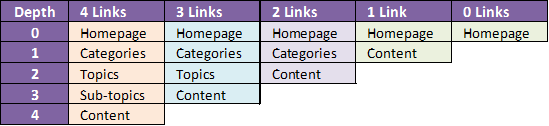
The following graphic shows the most typical ways website content gets organized. Structuring with categories, topics and sub-topics provides horizontal and vertical hierarchy.
While you can extend this infinitely, the accepted best practice is for pages to be four clicks or fewer from the homepage.
SEO Website Structure
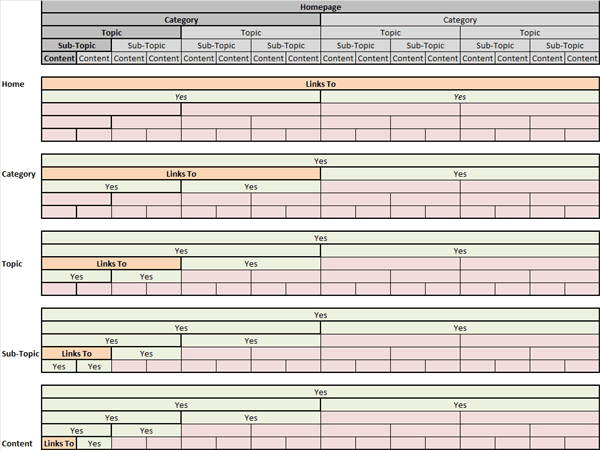
These are my preferred Strict Navigation Rules for a 0–4 depth website:
  • The Homepage links to all Category Pages (down)
  • Category Pages
    • Each Category page links to the Homepage (up)
    • Each Category page links to all Category pages (across)
    • Each Category page link to its own Topic pages (down)
  • Topic Pages
    • Each Topic page links to the Homepage (up)
    • Each Topic page links to all Category pages (up)
    • Each Topic page links to the all Topic pages within its Category (across)
    • Each Topic page links to its own Sub-topic pages (down)
  • Sub-topic Pages
    • Each Sub-topic page links to the Homepage (up)
    • Each Sub-topic page links to all Category pages (up)
    • Each Sub-topic page links to all Topic pages within its own Category (up)
    • Each Sub-topic page links to all Sub-topic pages within its own Topic (across)
    • Each Sub-topic links to its own Content pages (down)
  • Content Pages
    • Each Content page links to the Homepage (up)
    • Each Content page links to all Category pages (up)
    • Each Content page links to all Topic pages within its own Category (up)
    • Each Content page links to all Sub-topic pages within its own Topic (up)
    • Each Content page links to all Content pages within its own Sub-topic (across)
 SEO Internal Linking
As you grok this internal linking structure, keep in mind two things are happening here.
First, we are pushing PageRank down into the site. What may not be obvious is you are pushing PageRank back upwards. PageRank is a renewable resource.
After search engines measure a webpage’s raw ranking strength, they reuse some that authority by dividing it among the outbound links on the page and sending it along. Since every page links back to the homepage and category pages, this navigational structure gives those pages the most PageRank.
At this point you may be asking, But Tom, if the homepage and category pages are getting all that authority how do I make my content pages rank?
After all, the content pages are where you optimize for most keywords, right? This is where search engine optimization gets interesting. Your site architecture and internal link structure create the framework within which you optimize, but there is much more to SEO.

Taking Site Structure To The Next Level

Beginning with the top of your website, seasoned optimizers dislike generic categories such as products or solutions. Why waste all that ranking authority on generic pages when employing keywords as categories makes for a far stronger SEO strategy.
Can your turn your product lines into categories?
For example: Wedding Gowns, Bridesmaid Dresses, and Flower Girl Dresses are ideal categories for a bridal shop. Look at how www.amazon.com and www.zappos.com sets-up their categories. Try to emulate this.
Exceptions create high ranking opportunities. Cross-link to create SEO hub-pages. Send extra PageRank to important SEO pages.
If you have a Gasoline Powered Chainsaws page, each time you mention this, link to that page. Use sidebars or content windows to feature and link to your chainsaw page. Write multiple pages or supporting content that can link naturally to it, for example a tutorial on chainsaw safety or guide to properly cutting down trees or article called How to Survive the Upcoming Zombie Apocalypse will all work well.
The problem with creating cross-links to hub-pages is if you create too many links to too many pages, you eat away at your internal linking structure. Avoid this by limiting which hub-pages to cross-link to from your home, category and topic pages. Keep supporting content on the same level or lower in your website organization.
Make category, topic and sub-topic pages content rich. If your category pages are nothing more than links to sub-pages you waste ranking authority. Target these pages to keywords and fill them up with relevant content.
It always seems to come back to creating link-worthy content and having a strong link building and social media program to get off-site links, mentions and shares. The last thing you want is for all your off-site links to point to your homepage.
Yes, PageRank gets reused. But search engines limit or dampen the amount of authority with each re-pass. Having off-site links to many different pages not only sends ranking authority to the target pages, it extends the amount of PageRank which gets passed throughout your website.
Besides that, links to many pages is a basic signal of website quality, it increases a website’s search spider crawl budget, and extends the number of pages the search engines will index and include in their rankings.

Final Thought

Using internal linking to create a vertical site architecture is like setting-up a Monopoly board for game play. You still need to buy properties and add houses and hotels to have a chance at winning.
However, if you never open the box, put the game pieces on Go, lay out the Chance and Community Chest cards or set-up the bank, you cannot play the game.


Reference          :- http://searchengineland.com

EBriks Infotech :- SEO Company India SMO Company India  PPC Company India

Address              :- E-171,Sec-63 Noida(UP)-India-201301


10 Things Most SEO Consultants Hate

Having spent over ten years as an SEO consultant, I’ve gathered a list of “top ten challenges” (or, as I think of them, my pet peeves) about the industry and our clients.
I’m sure you’ve had similar experiences to share with our community. I’ll go first, and list out 10 things that challenge and push SEO consultants to come up with their very best efforts.

1.  Fascination With Quick Fixes

Our clients, normally savvy business owners, are strangely driven by the urge for “quick fixes” in their SEO. Even though they understand the complexity of SEO and the potential benefits from getting it right, many just want a quick win.
My clients are evaluated on their quarterly or annual results. Even though my convincing pitch with fact-based reasoning demonstrates that they will double revenue from organic search by taking a long-term approach and working on a 24- to 36-month timetable, I still see resistance. They don’t like this. They want faster results. They prefer 12 month horizons.
Often, I’ll get anxious client emails before board meetings. They’ll break down our organic traffic goal into a 12-monthly figure, get pretty graphs drawn, and then discover (to their dismay) that the traffic we’re receiving is nowhere near what we “agreed upon at our initial discussion.”
Businesses should understand that organic search is important, and it cannot be rushed. Quick fixes may deliver quick wins, but it is unreal to expect them to be sustained and long-lasting.

2.  ”But My Competition Does…”

One of the toughest questions I’ve had to field begins with, “My competitors are doing _____ , so why can’t I?”
Many sites ignore Google’s guidelines and exploit loopholes in the search giant’s algorithms. They indulge in practices like shady link-building, exact match domains, ranking on duplicate content, and so on. In the near term, sometimes, these techniques help them outrank other businesses.
As an SEO consultant, I get frustrated at hearing Google’s never-ending string of (rarely implemented) rosy promises and dire threats to discourage webmasters against such practices.
In Norway, we have 5 million citizens. That isn’t many. But when I’m responsible for SEO strategy at some of the biggest, highest-traffic sites in the country, I am frequently left red-faced at Google’s lack of effective responses to such under-handed and crooked tricks to game search rankings. My personal opinion is that Google isn’t quite good at filtering out low-quality content in Norway. Even when I report poor-quality sites, nothing happens.
There are times when I even feel sorry for my clients. Their competitors have been using tricky techniques for years, and yet nobody stops them or penalizes them for such actions. They make a lot of money through their shenanigans. On the other hand, my clients are practicing ethical and white-hat SEO, adopting best practices and respecting guidelines, only to find themselves outranked by low-quality sites. It’s frustrating for SEO consultants. Have you ever felt the same, or had similar experiences?

3.  The Conundrum of “Hourly Rates”

So, I’m called to bid on an SEO consulting project. I make a presentation, hand over my proposal… and a few days or weeks later, my prospective client will call to complain that my hourly rate is too high. They love everything else about my proposal, but try to negotiate a lesser rate, saying that my competitors claim they can do it at a lower price.
Well, that’s true. They can. And it’s because they have a different approach and attitude toward SEO. Instead, wouldn’t it be nice when clients look at how much more money I’m going to add to their bottom-line? At how quickly I can help them achieve their financial goals and targets? At how effectively I can help them grow their business?
Look, a good SEO consultant is so much more than just a technical specialist. A great SEO consultant is excellent with analytics. Armed with access to valuable data, a consultant can help with your business development needs, guiding you grow your business in new ways. It is meaningless to evaluate such value by “hourly rates,” yet we see it all the time. How do you deal with it?

4.  SEO Cannot Compensate For A Poor Product

SEO can’t fix everything. I know that’s contrary to industry-driven myths, but hey! If your product, service or customer care are mediocre or just not “awesome,” you should fix that first before you call in the SEO guy (or gal) to get you more traffic.
SEO can amplify your business results. If you have a great offer which adds value to people, SEO will help you expand your reach and help many more people while making a bigger profit.

5.  Learn To Say “No” More Often

I should follow my own advice! Sometimes I get a bad feeling when a prospective client calls for a meeting. Maybe he wants to switch agencies for the 3rd time in 2 years. He isn’t happy with his present SEO vendor, or recently had a confrontation, and so, wants to change consultants.
I’ve often found that these clients are impatient, frustrated, and difficult to work with. Any trivial thing can affect their behavior and attitude toward their SEO consultant. A sleepless night, a bad quarter, a rough review by their boss, and they’ll impulsively leap to random conclusions, second-guessing your judgment, and blaming everyone but themselves.
It’s a bad situation to be in, as a consultant. Such a client’s attitude can drain your motivation and mess up your mood. You have to promptly break off these relationships. Say “No” when you see it coming. Cry “Stop” when it begins with an existing client.
Yes, you may lose an account. But it’s still the right decision. Keeping on “energy vampires” as clients can have devastating consequences on the rest of your consulting business.

6.  An Obsession Over Hit-Counters

People love “hit counters.” Ok, maybe hit counters isn’t the right way to describe this. But, many clients still place disproportionate emphasis on page views, search rankings and other such low-quality KPIs (key performance indicators).
None of these correctly reflect your business’ performance. You need to focus on the right KPIs. Ones that are actionable, and which contribute directly to bottom-line profitability. Those are the ones you seek to improve through your SEO strategy.
In many clients’ eyes, ranking is still king. But, SEO consultants understand that a site’s placement in the SERPs is only a rung in the ladder to business success. Without an acceptable conversion rate, more sales and higher profit as a consequence, even a #1 ranking on Google will be worthless.

7.  SEO Is Still Icing On The Cake

A few business owners cherish a naive belief in the ability of SEO to transform everything and magically create results. So, they put off consulting an SEO expert until everything else is ready with their website development.
Unfortunately, when this poorly planned and constructed site generates sub-optimal results, fixing it will need expensive changes. It’s far better to involve an SEO consultant right from the planning phase so that all aspects of your commercial website will work in harmony and synchronize with other elements to deliver stellar results.

8.  IT Consultants Can Fix Everything

It still amazes me that my family will call whenever they have trouble with their printer, PC, mobile phone, scanner, or have a virus problem — just because I’m an “IT Consultant.” Sometimes, they’ll even call for help with their TV, cable connection, or satellite dish!
It’s the same story at work, too. Clients don’t see a difference between a Web designer, Web developer, paid search expert, or SEO consultant. They figure that “If you’re an IT manager, you should be able to fix everything that runs on electricity.” Well, that’s not how it works!

9.  ”Content Is Easy”

Sorry, it’s not. Unless all you need is to fill in some white space with text and stuff it with keywords.
Time and again, I hear clients saying they can handle content by themselves. I no longer go into raptures of delight when clients say they have a “good copywriter or writer on their staff.” Rarely, if ever, do those writers have a good understanding of SEO.
Whenever I’ve relied on these “inside experts,” I’ve been disappointed and ended up having to teach them how to do what’s needed. That also cuts into my SEO budget, wasting time that’s better spent on other SEO tasks. Does this sound familiar?

10.  Getting Paid Per Link

When the SEO discussion turns to link building, the issue of buying links crops up. In the aftermath of Google’s Penguin update, it’s weird to even hear that businesses dare buy links from people offering “pay per link” deals.
This is risky, and I always turn down such requests from clients. But, some still go ahead with shady or black-hat link building techniques, and then blame SEO consultants when the ax falls on their business’ head.
So there. These are my pet peeves about being an SEO consultant. I’m sure there are many others you’ve faced in your career. Please go on and share them in the comments below. Let’s get some discussion going on these vexing problems and talk about how to solve them.


Reference:- http://searchengineland.com

EBriks Infotech:- SEO Company India SMO Company India  PPC Company India

Address:- E-171,Sec-63 Noida(UP)-India-201301


How to Double Your Revenue With SEO

In 2012, I was privileged to handle SEO for some of the biggest Norwegian e-commerce sites. This is the story about how I doubled (and even tripled) revenue for them by following a simple, easy, yet unconventional approach that anyone — even you — can implement starting today.
At the heart of this accomplishment lie two things which are related to one another:
  1. A focus on uncovering user intent, and then filling that need
  2. The ability (and budget) to do all that’s necessary
This may sound easy, but when you consult with a business that is stratified and compartmentalized into watertight departments and divisions, this presents many challenges.

Part 1: Managing SEO Activities

The first half of this success story involves the approach I took in terms of strategy and implementation. With competition getting tougher by the year and the rules of the game constantly changing, putting together an SEO strategy that won’t quickly become obsolete is important.

A. Critically Evaluate The Situation

There have been major changes at Google over the past year or so. With local business search, maps have taken over the SERPs. More users are on mobile devices, with GPS and location data impacting results. Searches for people are more often dominated by authoritative social sites like Facebook, LinkedIn and Twitter. Yet, despite all these new developments, many of which have made the competition even tougher than before, SEO budgets remain the same.
To be effective, I had to think differently. My client sites already had large volumes of traffic, but tracking visitor counts without studying Web analytics led to an illusion of being in control — when really, they weren’t. I determined that it wasn’t just about getting more traffic. I had to get the right kind of visitors — people who would buy!
I had to adjust my strategy by stepping back to ask critical questions:
  • Where is Google headed?
  • Where will Web search be in the next few months? Or years?
  • What could I expect to blow up or become important?

B. Identify Trends You Can Leverage

By answering the questions above — and by digging deep into all available data, analyzing patterns, and studying clients’ current SEO practices — I came to several important conclusions:
1. Relevant Is No Longer Good Enough
People are on Google looking for answers. If search results don’t provide them, users will go elsewhere. Google wants to become the best “answer engine,” so it’s no longer good enough to provide a page of content that is “relevant” to a given keyword. If you’re not answering the searcher’s question, you won’t last long in the top spot.
2. Identity Is Important
Google wants to determine searchers’ identities and interests. It also wants to know who authors specific content, and how trustworthy and authoritative they are.
3. Sites Must Get Attention By Standing Out Amid The Noise
Rich snippets and authorship are affecting SERPs. It will soon become much harder to compete and win away attention from those who make use of these tools — even if you have the top spot and they don’t.
4. Online Is Global, Not Local
Products and services that are available for purchase online are less likely to show up in local search results. Traditional SEO campaigns are still necessary.
5. Personal Signals Are Critical
Google considers geo-location and GPS data while serving up answers to search queries and tailors results to your location. Additionally, people’s voices count for more, and social search is gaining importance.

C. Chart Out Your Strategy

Based on these insights, I took a step back to work on our strategy. Rather than rigging up advanced SEO tools and running complex audits right away, I had to draft an overall plan that was “evergreen” (or, at least, one that would survive for 12 to 24 months!).
So, what was the common factor among the insights above? What can you really do that will not become obsolete as the Web changes?
Simple. You find the user intent behind web search – and build your strategy around that.
It’s an old marketing cliche that guys who buy drills don’t want an instrument — they really want the hole. Realizing how this relates to SEO work will become your biggest “a-ha” moment.
When Matt Cutts says one should focus on the user, you should listen. Google’s attempts to simulate a human brain’s thought processes mandates that we move away from technical SEO and quick-fixes and move toward understanding user intent.

D. Uncover User Intent

I’ve written previously about SEOnomics, the complex interaction between human psychology, SEO and business economics. Every expert SEO consultant applies this approach to get inside the head of a client’s typical customer, understand their deepest needs and desires, and then weave this information into a winning SEO strategy that delivers great value. You can begin to figure out user intent by asking the following questions:
  • What do your customers want?
  • What are their biggest problems?
  • How are they affected by these problems?
  • What are the solutions they seek?
  • How badly do they need a solution?
  • What are they willing to pay for it?
The answers lie hidden within your analytics data. Web analytics are more than just a traffic counter. They unmask secret needs, intentions and expectations that drive prospective customers to a website. Keywords tell you what problems visitors have and what they are looking for to solve them. Searchers often want answers or more information. They are looking for assistance or reviews.
Web analytics can also reveal what they do after arriving at the website. What actions do they take? What path do they follow? What content is of interest? A talented SEO can even use analytics data to predict what will sell, what visitors want, and what they will do on the site.
All this analysis provides precious insight into consumer intent. It can serve as your guide to giving users a great on-site experience. It will let your business solve their problems and convince them to spend money on your products and services. Knowing what’s going on in your ideal prospect’s mind, you are now ready to take action.

E. Think, Act, Measure & Then Act Again

Build smaller, focused, iterative processes rather than big and time-consuming ones. Whenever a change we made was successful, we did more of that. If it wasn’t as effective as we expected, we did less of it — or even stopped doing it. This may not sound revolutionary or exciting, but was one of the most important ingredients of our SEO success in 2012. These were our insights from using this strategy:
  • Things change rapidly online. You must adapt fast. Yes, strategy matters. But a tactical focus and the freedom to respond quickly to changes will ensure faster deployment in your e-commerce store.
  • Before you act, slow down enough to make sure you are working on the right things. Taking time to step back and evaluate is not a sign of weakness, but of strength.
  • Don’t spend money on anything that is not measurable. Any important variable is measurable. Measure everything — but only include actionable data on your list of things to review.
  • Focus on strategic and economic goals. Remove everything that’s merely “nice to have,” because it will only distract or confuse.
Generic search
Result: 113.29% Increase In Generic Search Traffic.

Part 2: Managing the Client

If you’re working with smaller business clients, this process is relatively simple and straightforward. But as the size of your client business grows, so do the problems. You’ll have to interact with more people, sell them on the value what you do, and then get them to buy in to your strategy, allot you an adequate budget, and stay out of your hair until you get things done!
Unless you get this right, you’ll waste most of your time on internal squabbles and power struggles, answering to several bosses, and fighting budget cuts. Not surprisingly, such a situation leads to having less time to focus on implementing your SEO strategy, resulting in a poor performance.
And then, everybody will blame you!
Here’s how I get around such problems, following a set approach that you, too, can adopt profitably.

A. Position Yourself To Win Trust

For a marketing manager in a large organization, SEO is just a tool. The business owner or CEO may not even be aware of your role as an SEO consultant. It’s difficult to get in a position to talk with the right people.
But that’s because you’ve not demonstrated your true value.
Here’s how you can do it: stick to simple, vivid descriptions. Saying “Google is responsible for xx% of your online revenue” will be very effective. “Google” may not mean much to a corporate executive — until he knows it brings 50% of the business’ online revenue.
Once he is aware of this, he’ll see you in a different light! He’ll come to you. He’ll depend on you. And for SEO consultants and internal marketing managers alike, this is a nice position to be in.

B. Keep Things Simple

For board meetings, I simplify my data into easily understood presentations. If someone unfamiliar with SEO makes investment decisions about SEO campaigns, you must provide your intermediary with simplified information that can be conveyed quickly and effectively — and ensures that you get the budget you require.
Extract the most critical financial data (not SEO terms or ranking data) and present this as a one-page document. With the aid of a designer, I made an infographic that the e-commerce manager could display in the office. Everyone understood it. It spoke for itself.

C. Never Justify

Most clients just want your conclusions. Not your rationale. Or arguments.
Build trust – then trust your customer to trust you. If you don’t succeed at this, keep trying… because without trust, you are doomed. You’ll waste time trying to convince your client, or defending your budget – instead of growing your client’s business.

D. Work Together

“If you need to go fast, go alone. If you want to go far, go together.”
Don’t be the “SEO geek” — adopt a “business development” mindset. Work hard to get close to your client. Involve your employees in various processes. Your task is to make everyone understand how important SEO is for the company. Show department heads that you are helping them deliver on their own sales results and growth.
Once I started reporting my results in terms of revenue rather than traffic, more people understood what I was talking about — “10 million unique visitors” is not as meaningful as “$2 million in profit.” Everyone understands money. Cash is king!

E. Get Clarity Before You Begin

Ask why. Ask often. Don’t begin anything before you understand why you’re doing it. Then (and only then), figure out how best to do it.
Ensure that web analytics and business goals are aligned. Measure the right data. Verify that it can be acted upon. Make a dashboard in Google Analytics (or other web analytics tool) and share it with everyone. Buy a screen and place it in your office where everyone can see.
  • How much money did we make from Google today?
  • Are we on target?
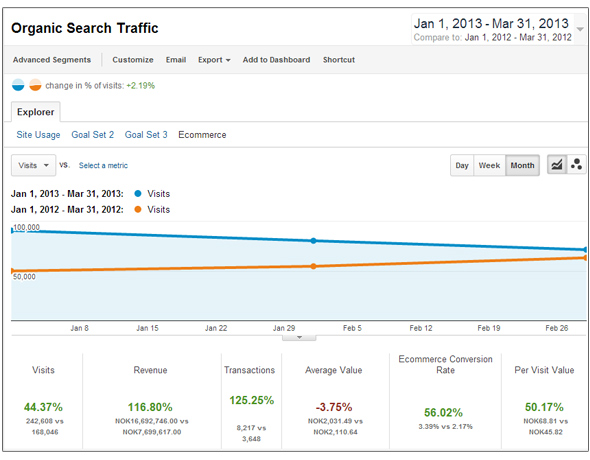
This screen motivates people and spotlights the impact of SEO on revenue. For one of my clients, Google accounted for 60% of revenue. Demonstrating this visually was very powerful.
Q1 2013 revenue

Takeaways & Lessons

  1. Keyword research and analysis matters, but the user intention behind those search terms is crucial. Optimize your site for people, not search engines.
  2. Your SEO toolbox and the mix of your tools still means a lot. No single tool can tell you everything you need to know. In my own toolbox, I always have the Google Keyword Tool, Market Samurai, Search Metrics, SEOmoz Pro, Mozcast, Screaming Frog SEO Spider, Open Site Explorer and Microsoft Excel. For project management and collaboration, we use Jira.
  3. Keep things simple so that it is easy to explain your process to clients. Getting them to buy in to your strategy and winning their trust early on can be crucial to the success or failure of your SEO work, especially when you work with bigger businesses.
  4. Strive for constant improvement. Listen to real experts to constantly refine your process.
  
Reference:- http://searchengineland.com

EBriks Infotech:- SEO Company India SMO Company India  PPC Company India

Address:- E-171,Sec-63 Noida(UP)-India-201301


8 E-Commerce SEO Tips Gathered From A Decade Of Consulting

In the comments of my last column about how I doubled e-commerce revenue for clients by focusing on user intent, readers asked for some more specific e-commerce SEO tips that they could apply in their own client work.
Today’s article shares some valuable lessons gathered over a decade of SEO work for e-commerce clients. These 8 e-commerce SEO tips have the power to transform any online business and boost profits.

1. Understand The SEO Impact Of Information Architecture & URL Structure

E-Commerce SEO Tip #1
Like most SEO consultants, I am often contacted late in the Web development process, well after information architecture and URL structure have been determined. Generally, the site is almost ready for launch at this point — or, in some cases, already launched!
If so, it is an SEO nightmare. Content has been created. Product catalogs have been imported. Search engines have crawled and indexed the site. Prospective buyers are arriving. And, the internal structure — from an SEO standpoint — is a mess.
Without a proper URL structure, internal pages are competing against each other rather than strengthening the overall site. Duplicate content issues run rampant, thanks to URL parameters, session IDs and printer-friendly versions. Advanced filtering and search functions, intended to enhance user experience, actually end up compounding this problem.
Usually, the store owner hires a company to flesh out a design, implement and code special functions, and upload the finished site — all before the project itself has been finalized. Things then go in many different directions; and at some stage in the process, they decide to call in a consultant to slap on “SEO magic.” They’ve heard that SEO is very effective at driving more traffic and want to try “every little bit that may help.”
This is the most frustrating part of being an SEO consultant. We’re called in too late. A lot of adjustment and re-coding is required. Even then, some online stores won’t be able to meet the market’s needs without a complete make-over of the website. This is time consuming and expensive.
E-commerce SEO Tip #1: Get your Web designer, information architect and SEO consultant working together right from the beginning. The result will be a more effective, better-optimized website that is easy for prospective buyers to use.
My fellow columnist Tom Schmitz offers some great advice about Web structure and internal linking in his recent post. I delved deep into this in one of my previous columns, with practical suggestions on how to structure content for e-commerce sites.

2. Recognize Causes For Duplicate Content & Find Solutions

When I analyze sites for new SEO clients, they often have serious duplicate content issues. Fixing this can be complicated without modifying the entire design and code.
Duplicate content issues are usually the result of poor planning, careless information architecture and non-intuitive website structure.
The use of URL parameters, session IDs and printer-friendly content versions are common culprits in e-commerce store websites. The situation gets muddied even further when identical content is published under multiple categories such as [campaign] or [offers] in addition to their regular place in the content hierarchy. These unique scenarios must be recognized and prevented proactively in the planning phase itself.
E-commerce SEO Tip #2: Before they start coding, make sure that developers are aware of the potential for duplicate content and how to resolve these issues.
Both designers and developers must be familiar with the pitfalls of related issues such as advanced search and filtering, the robots.txt file, and the relative merits and risks of meta directives or robot exclusion (including when not to use them!). Pagination is another potential quagmire; and, it is especially important to ensure correct implementation of pagination attributes for Google.

3. Don’t Waste Link Authority On Ineffective Link Structure

Effective link structure for an e-commerce SEO project depends upon information architecture, URL structure, and the manner in which products are categorized and organized in your e-commerce store. If your structure is poor, with products arranged in a haphazard manner instead of being in logical categories or sub-topics, your link architecture will be ineffective from an SEO standpoint.
E-commerce SEO Tip #3: Organize products in an e-commerce store by category and sub-category, based on topics and sub-topics, in a way that is reflected in your URL hierarchy.
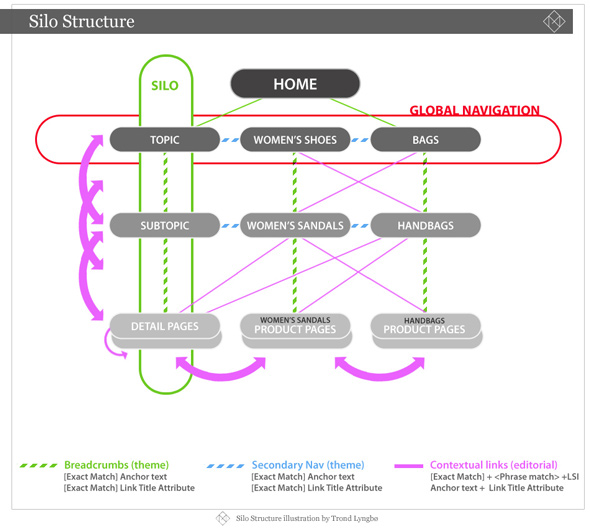
Doing this enhances your e-commerce website’s optimization and improves usability for human visitors. Whenever new products are added to a sub-category, your breadcrumb navigation trail ensures new links to each level in the URL hierarchy, all the way back up to the category page and home page. By employing sub-navigation menus within specific categories, you can link to other relevant categories higher up in the structure.
With good keyword analysis and by planning exact match anchor texts, you will practically set your internal link building on auto-pilot. Each time you add a new product page (e.g., for a new pair of running shoes) to your site, you’ll not only boost the [shoes/running-shoes] level of the URL, but simultaneously pass along link juice upward in the hierarchy to the [shoes] category, as well.
Section/category level menus that link to relevant categories ensure that Google’s crawlers can find their way to all sections of the site and see pages in context with other content to easily decide how to rank them.
It is best to avoid mega-menus and drop-down menus which cause a flat URL structure and sometimes link to less relevant parts of the site, thereby leaking authority, power and Page Rank.

4. SEO Automation Can Be A Good Thing (Sometimes)

The word “automation,” when associated with SEO, produces negative connotations. Typically, I would shun anything to do with “automation” of SEO; but, there are some exceptions where it is important to facilitate automation. One such exception is a situation in which you have programmers who can automate on-site elements (such as title tags) based on a format determined by the SEO consultant.
In e-commerce stores with thousands of products, this practice will come in handy. Elements like title tags can be automated to present extremely user-friendly information while including the right target keywords.
E-commerce SEO Tip #4: While working with large e-commerce sites, provide developers with information about how to automate the creation of SEO-friendly title tags and meta descriptions for new pages.
This will save everyone time in the long run — so getting it right is important, even if it takes longer than you would typically spend on title tags. Remember, this deployment will be site-wide. Your instructions must clearly tell the developer how the title tags and meta descriptions should be worded, based on the content displayed on a product page of the e-commerce site.
Using the individual product name or title in H1 tags, as well as in the title tag, is one simple way to achieve this, and your developer can program it quickly and easily. You can also dynamically create meta descriptions for each product page by gathering text from the page’s content itself.
This is a good beginning, but there’s more to do. Rich snippets help increase CTR on search results pages, and with your help, a developer can provide excellent titles and meta descriptions even without any SEO knowledge.

5. Smaller Iterative Processes Are Super Effective

Fail to plan, and you plan to fail. Your SEO strategy is all-important. But, when working on tactics and implementation, one factor matters more than anything else — and that is “starting small.”
Too often, e-commerce site owners want to change everything at once. Transform the site. Make all pages rank high on Google. That involves doing too much, and taking too big a risk without knowing if it will work at all.
E-commerce SEO Tip #5: It is infinitely more effective to run smaller processes that focus on a limited portion of the site.
Test the change. See if it works. When you know what to do and how to do it, roll out the change across the site. Start with the most important things first. Most developers and designers have limited time. If the work is outsourced to a third party, they most likely use scrum or similar systems and timing is important. Handing them one task at a time usually results in quicker progress.

6. Implement E-Commerce Tracking

Many website owners look at traffic growth as a good sign that they are moving in the right direction and that they are doing something smart and effective. But, what if the traffic doesn’t convert into sales?
E-commerce SEO Tip #6: Turn on e-commerce tracking with Google Analytics to show exactly how much money you are helping clients make.
Most of my clients are already using Google Analytics. As one of my first actions as a consultant, I ensure e-commerce tracking is configured and implemented. This will reveal the profit boosts generated with my SEO improvements. Showing results in dollars is much more effective than increasing pageviews, rankings or clicks. Cash is king.
Dealing with clients is much easier when you don’t have to keep on selling them on the value of your services — after all, your client is better served when your energy and attention are focused on higher priority activities. E-commerce tracking is also a great way to quickly identify areas where the client’s online (or offline) marketing is not effective or adding enough value to the business.
Armed with data, I can position myself as being more valuable to the e-commerce business’ bottom line, instead of being perceived as just a “Google-fixer.” I get more billable hours, and the client stops worrying about how many hours I spend — because each of them brings in a high ROI. It’s a win-win situation.
When you outline a plan to increase revenue by 100% over the next 12 months, and then implement it while sharing your progress in Google Analytics, you will get the support and buy-in necessary to execute your proposed plan and carry it through to completion. Your budget will be sanctioned without protest, because who doesn’t like the idea of earning $10 million for an investment of a mere $100,000.

7. Traditional SEO Is Still Relevant To E-Commerce SEO

Yes, old is gold. E-commerce sites often under-perform on product pages. This might be traced to problems with coding, text, and other content. There may be too little product information, or a lack of unique content, or duplicates of material found elsewhere on the site.
E-commerce SEO Tip #7: Without product text, it is almost impossible to rank and drive organic search traffic to e-commerce websites.
You need content. Without images, video and proper keyword targeting, it is next to impossible for your client to compete in a tough niche. There are many guides to help you and checklists to follow to ensure you’ll get it right.
For starters, avoid re-publishing content from elsewhere on your site or from other online resources (including competitor and vendor websites). Google frowns on duplicate content, and your e-commerce site will not rank well.

8. Create Dashboards — And Report In Cash

It is hard to convince clients with just flashy pictures and showy graphs or charts. You can talk about visits, clicks and views till you’re blue in the face and not make an impact on hard-nosed business owners. Many of them won’t even understand what you’re saying, and this means you’ll have to work hard to win credibility — and retain your budget.
E-commerce SEO Tip #8: Make a dashboard in Google Analytics, and show them how much money you have helped them earn through your SEO efforts.
Compare it against earnings from other elements of their marketing mix. Proving that your SEO efforts are bringing in the dollars is key to winning repeat business. Construct your dashboard to report the most important numbers.
Focus on cash. That will strengthen your position in the client’s eyes. They will see you as someone higher up on the food chain, one who deserves higher priority. No longer will they see you as “just that SEO guy (or gal).”
Good SEO consultants are decent Web analysts, as well. But, clients don’t know it. Using dashboards, I can reduce (or even eliminate) time wasted on creating slides or spreadsheet presentations to convince clients of my value. This frees up time to spend on more valuable activities that further increase the profit I can generate for clients.

More Big Lessons & Takeaways

  • SEO is not icing on the cake to be slapped on at the very end. It must be baked into the makings, because it’s an essential ingredient.
  • There are no out-of-the-box, ready-made SEO optimized e-commerce platforms. The “SEO-friendly” ones just allow tweaking and optimization by SEO experts after they are installed and configured.
  • SEO is not a quick fix. Clinging to this belief can cost you many lost sales.
Now that I’ve shared some e-commerce SEO tips gathered over my experience working with many large clients, I’d love to hear from you on this issue, as well.
  • What do you think about these tips?
  • What are your most effective e-commerce SEO tips?
  • What are your biggest challenges in working as an SEO consultant with e-commerce clients?
  • And finally, are there any other questions you’d like to have answered?
Please share your thoughts, suggestions and comments below, and let’s have a spirited discussion about effective e-commerce SEO.

Reference:- http://searchengineland.com

EBriks Infotech:- SEO Company India SMO Company India  PPC Company India

Address:- E-171,Sec-63 Noida(UP)-India-201301


You Find Me On This:

Wednesday, 5 June 2013

10 Video SEO Tips To Improve Rank and User Experience

show that 17% of people spend less than four seconds on a website, but they are willing to spend 2.7 minutes watching a video online. Knowing that the average television commercial is 15-30 seconds long, think of what you could do with the attention-span-eternity that is 2.7 minutes of video engagement gold.
Video is powerful.
But if a video plays and no one is there to hear it, does it make a sound?
This post covers in short-form (because I know I’ve only got your attention for four seconds) 10 video SEO tips to help you create content that gets views — from taking into consideration quality and substance, to making sure your videos are seen and indexed by search engines so that they can be seen and shared by humans.

Focus On Quality

YouTube video still image featuring a man and a photography set
This photography tutorial offers a good example of a video set that is thoughtful and engaging. It’s important to create engaging video experiences like this if you want to see 231,000 views.
1) Focus on people first:
Before we start listing off ways to drive people to your content, it’s important to reiterate that you need to be proud of the content you’re driving them to. If your video has poor sound quality, or a script that sounds like you just woke up with a hangover and recorded this video while you were drinking a Bloody Mary, you’re not going to keep them for 2.7 minutes. You don’t want them to stay because your video is a train wreck and they can’t look away. For better or worse, the video content you publish inevitably represents your brand, so make it better not worse.
2) Likes, Comments, and Shares matter: High-quality, benefit-driven, video content that keeps your viewer engaged means more Likes, Comments, and Shares. More engagement means more people are seeing your content, not only through direct viral sharing, but also in the SERPs as both YouTube and Google use engagement to help them identify and deliver quality content.

Use Your Words: How To Optimize The Language You Use

3) Perform keyword research: Google reads words to discern what content is about, so using exact search query phrases to describe your content will go a long way in helping to get your content ranked on page one. Learn how to research keywords, pick one keyword phrase to target per video, then put your keyword phrase in your video Title, Description, and file name (ie: keyword-rich-name.mov).
Example of incorrect closed captioning in a YouTube video
Make sure to review and edit the captions YouTube creates for your videos. In this example you can see YouTube misheard the speaker saying “popular to this day” as “popular Tuesday.
4)  Write a script and upload a transcript: Google will read the transcript of your video so make sure to write a script for your movie and actually say your keyword phrase in the movie. While there’s no rule of thumb about when to mention your phrase, earlier is always better than later.
5) Use YouTube Captions as a transcript alternative: If you don’t have the resources to create a video transcript from scratch, YouTube can generate crawlable closed captioning for your videos. If you take advantage of this tool, make sure you review the captions YouTube generates and make edits as needed.

Use YouTube to Host and Embed Your Videos

6) Host your video on YouTube: YouTube is an easy to use free space to host videos, and it also happens to be the second largest search engine. If you want your video content to rank in Bing (269 million searchers per month), it makes sense you should also want to rank in YouTube, which now sees more than 1 billion unique users every month.
7) Embed YouTube videos on your website: If you want to rank well for a video in Google or YouTube it is worth your time to create a rich-media content page on your website to support the embedded video. The content landing page should include your embedded video, as well as text and still images that describe or supplement it.
Diverse, rich-media landing pages are engaging, offer a strong user experience, and give Google a lot of context that helps improve your SERP rank. Embedded YouTube videos can also help improve your YouTube SERP rank as number of views is a YouTube ranking factor and video views received on your landing page count toward your overall YouTube video view-count.
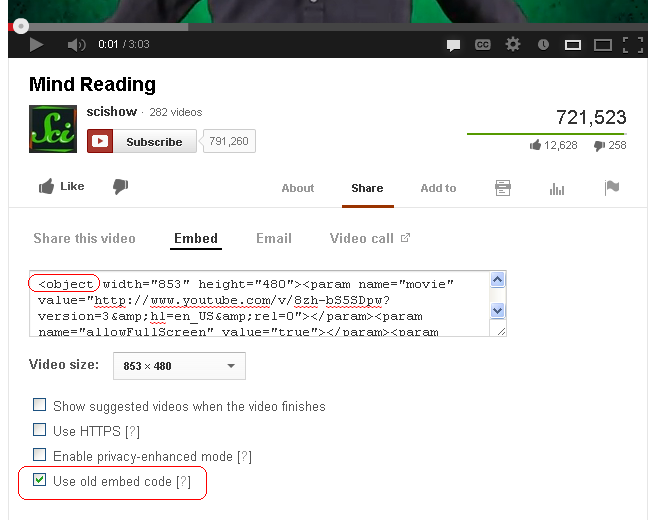
Using the YouTube old embed code
To ensure your videos get crawled, make sure to embed movies using the “old” YouTube embed code.
8) Use the “old” YouTube embed code option: When you select the Embed option in YouTube you will see the formulated code, a Video Size pull-down menu, and four preference options; the last of these four preference options says “Use old embed code.” If you embed a video on your website or blog, make sure this option is selected. The old embed code gives you an <object>-based embed code that can be crawled naturally by search engine spiders (as seen right), while the new embed code puts your movie into an iframe that renders your movie uncrawlable.

Get Technical: Sitemaps and Schema

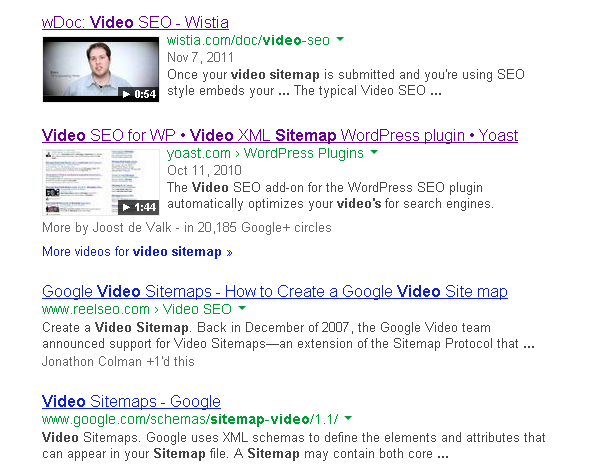
video-sitemap-serp-examples-crop
In this example the first two websites have video Sitemaps submitted, and accordingly, video thumbnails that show up in the SERP results. As you can see, the video thumbnail really makes the entries stand out in the listing.
9) Create video Sitemaps: If you include a video on your website, creating and submitting a Sitemap for that video will make it easier for search engines to find and index your videos; return SERP results that lead people to watch the video on your website, rather than YouTube; and improve the visual presence of your SERP listing with the addition of a video thumbnail.
Creating a video Sitemap is something that anyone can do using any number of video Sitemap generators and Google Webmaster Tools. If your video is self-hosted, check out how to create a video sitemap at Google Webmster Tools, or learn how to create a sitemap for an embedded YouTube or Vimeo video at the Moz blog.
10) Use Schema.org markup: Schema is a form of microdata HTML markup that provides additional information and context to search spiders. Google has called Schema “the recommended way to describe videos on the web,” and as such, is a recommended addition to help make your video content fully optimized and accessible to search spiders. Learn how to use Schema.org for video.

Paper that reads "Ask and ye shall receive! Maybe"


The Tip Of The Iceberg…

Video marketing is a vast industry that could easily merit a few thousand words. I’ve tried to keep it brief in this article, but I would love to know what questions you have. Leave your video SEO questions in the comments section below and you may get one of my world-famous 600-word comment responses, or even a blog post dedicated to answering your question in depth.


Reference         :- http://www.bruceclay.com

EBriks Infotech :- SEO Company India   SMO Company India   PPC Company India

Address            :- E-171,Sec-63 Noida(UP) India-201301


Bing Ads Now Has Time Saving, Pre-Formatted Excel Reports

This is one of those minor features that will bring a smile to any PPC manager’s face. Microsoft has added Excel to the output options in the Bing Ads report center. But that’s not the exciting part.
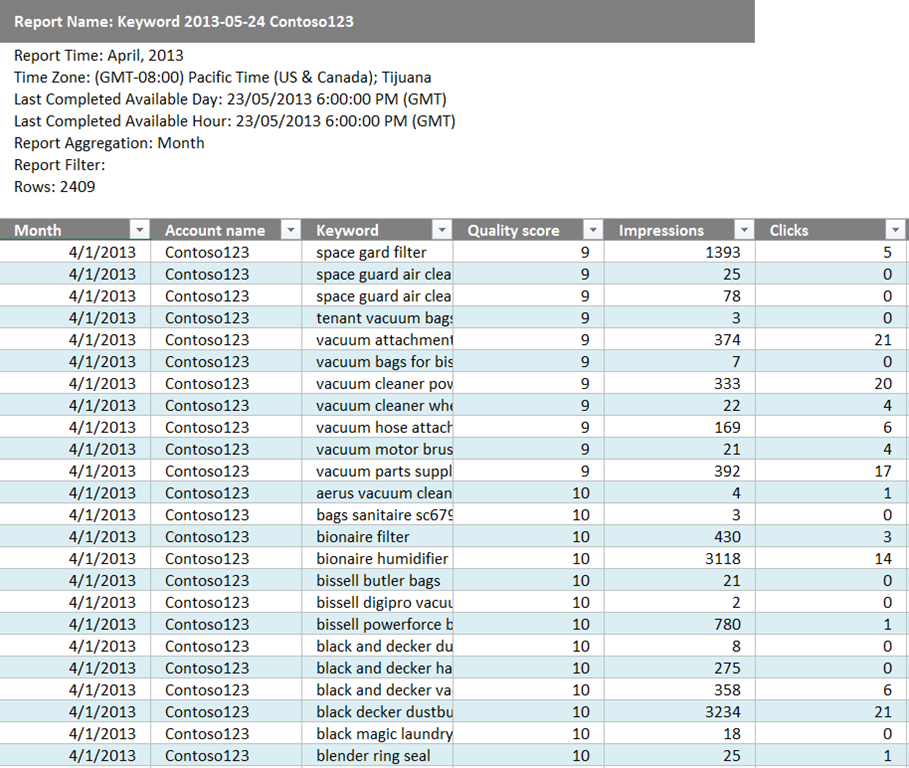
What is exciting is the fact that upon downloading to Excel, reports are already formatted and set with column filters for easy sorting and pivot table and chart creation.
There’s no need to waste precious time tinkering with basic formatting — deleting rows here, adding rows there, setting filters – after each download in order to get reports ready for actual analysis.
Here’s an example of what an Excel report looks like upon download from Bing Ads:
Bing Ads New Excel Download ReportTo download reports to Excel, set the Format field to “Excel” in the dropdown menu when in the Reports center.


Reference          :- http://searchengineland.com

EBriks Infotech :- SEO Company India   SMO Company India     PPC Company India

Address              :- E-171,Sec-63 Noida(UP) India-201301